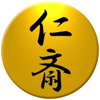
During His life, Meishu-Sama has used many names, according to the epoch´s occasion and using.
Jikan
Jikan means “Kannon himself” (ji = jibun = himself, Kan = Kanzeon). Actually, Ji means the person himself, and Kan means contemplation. Therefore, Jikan means instrospection, the inner self-observation, or the observation which the “self” does of its own interior conditions.
This way, He introduced himself as Kanzeon Bossatsu.
Works created under the Jikan nickname:
Jinsai
Jinsai was the name which Master used to sign the texts related to Johrei, the main objective of all Salvation activities taught by Him.
The name, whose meaning is “Mercy and purity of heart to adore God”, was used by Meishu-Sama from 1934 to 1936.
The texts about Johrei can be read in section Johrei, in Teachings.
Akemaro
“Akemaro, the name which I use to sign the waka poems, was chosen for the following reason: the Crown Prince´s birthday is on December 23th, 1933, and the day and the month of his birth is the same as mine. I will never forget that, on December 23th of 1933, due to the members wish, I celebrated my birthday for the first time since I was born. As such, to celebrate the prince´s name which was announced as Akihito, I chose the name Akemaro.”
Akegarassu
Around 1923, when Meishu-Sama returned to the Oomoto fold, literary activity was closely linked with the religion. In 1927 the Meiko Group was formed as an Oomoto literary society and it published a monthly magazine that specialized in waka verse and the kind of haiku known as crown-linking or cap verse. In this variety of seventeen-syllable haiku , one person set the first line of five syllables – the crown or cap – and someone else added the second and third lines, of seven and five syllables, respectively, to complete the verse. The practice had begun as a literary game around the end of the eighteenth century. Master Okada became a regular contributor to the magazine. Besides religious verses about His search for God, He also published others on a wide range of topics, including nature and human feelings, as well as some dialogue verses, which dealt mostly with love. His poetry reflects the free range of His heart over a broad spectrum of human activities.
Every month the group solicited waka and crown-linking verses. Each month, the oustanding poet was given a scroll and a person who earned five scrolls was permitted to use the literary pseudonym Moon-house ( Tsuki-no-ya ) Master Okada and His wife Yoshi both received this honor.
Owing to the ready wit and skill that Master Jinsai showed, Onissaburo Deguchi gave Him the nickname Assanebo Kiguetsu (Late-Sleeping Bright-Moon). He presided at poetry meetings and was responsible both for choosing the best verses and for presenting His own compositions. Later, when He tried to reform Himself of sleeping late in the mornings, He changed His nickname to Akegarassu Aho (Dawn-Crow the Fool), and He claimed that this helped teach Him to get up early.
Following some examples of His compositions:
“Intoxicated by New Year´s wine
The Devil looks like the Buddha –
Greeting the fresh spring.”
“Dozing off to sleep –
Economically I spent
Sunday afternoon.”
“Choosing our eaves
As a house of thousand years,
They have now arrived,
Flitting here and darting there,
The swallows that we love.”
Shin-no-Sei
That was the name used by Great Master to develop His work on non-agrotoxic natural farming.
Although Master Okada conceived a method of farming without fertilizer and established its techniques during the 1930´s, a general movement for this type of agriculture came about only after World War II. In December 1948 the first issue of the monthly magazine Heaven on Earth appeared. In it Okada published an article titled “Cultivation without fertilizer”,under the name Shin-no-sei. Afterward, special issues on farming appeared from time to time. Efforts were made to popularize the method, and gradually it spread throughout the country.
Since October 1950 this new technique has been known formally as Nature Farming. In December 1953 the Nature Farming Society was established to disseminate information about Nature Farming independent of the religious movement. At that time Okada composed a series of twenty-seven verses under the title: “Staff of Life”. Two of them read:
Since long ago
Farmers have been respected
As treasures of the land,
But true help for rural people
Is only beginning now.
To use a shallow
Bit of science
To probe something as deep
As the mystery of the Earth
Is certain stupidity.
Meishu
Untill April 2nd, 1950, Master was called by His disciples as “Dai Sensei” (= Great Master). Then, following the Divine orientation, He changed His name to Meishu-Sama (The Lord of Light). Mei means “Sun and Moon”, and Shu means owner, Lord.
This way, the junction of Sun and Moon (or fire and water) generates the Light, a reference to the power owned by Him through Nyoi-no-Tama, the Light Ball given Him by Kanzeon Bossatsu.
Messiah
On June 5 the heads of churches and other important gathered at Meishu-Sama´s Minaguchi-cho residence in Atami. Though very brief, it was their first meeting with Okada since his stroke in April. He said: “All the mysterious phenomena transforming my body signify the birth of a messiah, a lord of salvation. This is not mere conjecture but a fact. I myself was strange feeling after having become so old. It is interesting that my skin has become soft, like a baby´s. And you can see for yourselves that my hair is becoming to resemble that of a blacker. My barber said my hair is beginning to resemble that of a child. The white is gradually disappearing, becoming black…
Messiahship is the highest spiritual office. In the West a person of such rank is referred to as a king of kings. My appearance signifies salvation for humanity. This salvation will be a great event.”
On June 15, 1954, just ten days after the June 5 meeting, a ceremony to commemorate Master´s new spiritual office was celebrated at the Hall of Worship, which was then virtually complete. Master´s condition, however, was not encouraging, and it was only with help that He was able to mount the podium.
Because it was Meishu-Sama´s first public appearance in two months, more than ten thousand people gathered from all over Japan to attend the ceremony. He dressed completely in white that day and for the first time since His illness was able to greet the followers briefly. During the two months since His purification, Master Jinsai has become fully aware both of His role as a Lord of Salvation and that it was time to reveal Himself to the world. People around Him considered the lines that had appeared on His hand and the changes in His hair to be the physical signs of His new spiritual office. For about two months after the ceremony, He occasionally referred to Himself as a Messiah, thus making the appearance of a Lord of Salvation known to the world.