THE CITY OF KYOTO
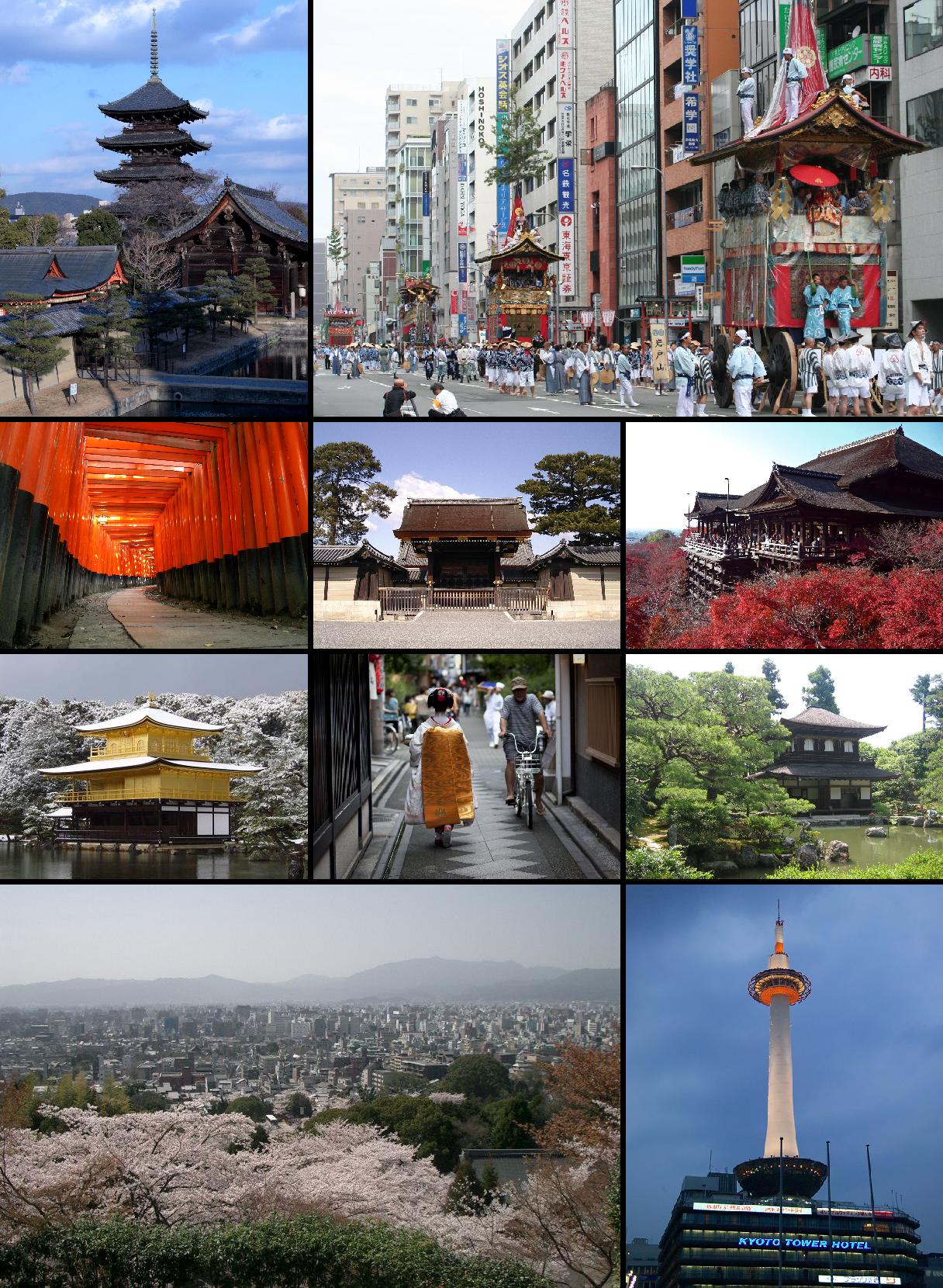
Kyoto (京 Kyo = Peace, 都 To = capital),is the capital city of Kyoto Prefecture, located in the Kansai region of Japan. For over a thousand years, Kyoto was the Imperial capital of Japan but is now a major part of the Kyoto-Osaka-Kobe metropolitan area.
During the 8th century, when powerful Buddhist clergy became involved in the affairs of the Imperial government, Emperor Kanmu chose to relocate the capital in order to distance it from the clerical establishment in Nara. His last choice for the site was the village of Uda, in the Kadono district of Yamashiro Province.
The new city, Heian-kyō (平安京, “tranquility and peace capital”), a scaled replica of the then Chinese Tang dynasty capital Chang’an, became the seat of Japan’s imperial court in 794, beginning the Heian period of Japanese history. Although military rulers established their governments either in Kyoto (Muromachi shogunate) or in other cities such as Kamakura (Kamakura shogunate) and Edo (Tokugawa shogunate), Kyoto remained Japan’s capital until the transfer of the imperial court to Tokyo in 1869 at the time of the Imperial Restoration.
The city suffered extensive destruction in the Ōnin War of 1467–1477, and did not really recover until the mid-16th century. During the Ōnin War, the shugo collapsed, and power was divided among the military families. Battles between samurai factions spilled into the streets, and came to involve the court nobility (kuge) and religious factions as well. Nobles’ mansions were transformed into fortresses, deep trenches dug throughout the city for defense and as firebreaks, and numerous buildings burned. The city has not seen such widespread destruction since.
In the late 16th century, Toyotomi Hideyoshi reconstructed the city by building new streets to double the number of north-south streets in central Kyoto, creating rectangle blocks superseding ancient square blocks. Hideyoshi also built earthwork walls called odoi (御土居) encircling the city. Teramachi Street in central Kyoto is a Buddhist temple quarter where Hideyoshi gathered temples in the city. Throughout the Edo period, the economy of the city flourished as one of three major cities in Japan, the others being Osaka and Edo.
HEIAN-KYO (THE PARADISE OF TRANQUILITY) – THE PROTOTYPE OF KYOTO
In 1951, during His trip to Kyoto, Master Jinsai became aware of another important part of God´s plan: the stablishment of a third center, in addition to Hakone and Atami, as Sacred Grounds. On the basis of His revelation, He explained the necessity of the Kyoto Sacred Grounds. Hakone represented the aspect of fire, Atami represented water, and Kyoto, earth. By completing these three sacred grounds, a trinity would be formed, and God´s work would progress. In the spring of 1952, on his third tour of the Kansai region, his idea for the Kyoto grounds began to take concrete form.
In the northwestern part of Kyoto, in the Sagano area, is a restful pond called Hirosawano-ike. It had been well-known since ancient times as a place for enjoying moon viewing. Lying at the foot of a range of gentle hills stretching to the north, the Hirosawano-ike area retains a rural charm and is a scenic spot combining the elements of earth and water.
When He visited Sagano on May 30, 1951, the second day of the first trip to Kyoto, Master Junsai was immediately taken with the area and gave instructions to His assistants to buy land there. By coincidence, property along the shore of Hirosawano-ike was put on the market the following year. Then He gave the name Heian-Kyo , or Paradise of Tranquility, and designated as the third Sacred Grounds.
CONSTRUCTIONS OF HEIAN-KYO
Kami-no-Ma (“God´s room”) – Room where Meishu-Sama used to be visited and worked.
Shunju-an (“Retreat of spring and autumm”) – This beautiful wooden house is built in pure Japanese style and contains approximately 228 square meters. Between 1951 and 1955, Meishu-Sama traveled throughout western Japan seven times and used this place for the training of senior staff members from 1953.
Chihan-tei (“Pavilion beside the pond”) – This building was given this name because it was built beside Hirosawa Pond, a feature of the Sagano area where the Heian-kyo is located. At present, the building is used by members for seminars. On the same site is the Rakusei Dormitory for the students of the Kyusei College. The Chihan-tei is a wooden building with about 298 square meters.
Mokiti Okada Memorial: The Mokiti Okada Memorial was founded in April 8, 2015, at Heian-kyo. In 2014, was made the Foundamental Stone Ceremony.


