Ukiyo-e[a] is a genre of Japanese art which flourished from the 17th through 19th centuries. Its artists produced woodblock prints and paintings of such subjects as female beauties; kabuki actors and sumo wrestlers; scenes from history and folk tales; travel scenes and landscapes; flora and fauna; and erotica. The term ukiyo-e (浮世絵) translates as “picture[s] of the floating world”.
Edo (modern Tokyo) became the seat of government for the military dictatorship in the early 17th century. The merchant class at the bottom of the social order benefited most from the city’s rapid economic growth. Many indulged in the entertainments of kabuki theatre, courtesans, and geisha of the pleasure districts. The term ukiyo (“floating world”) came to describe this hedonistic lifestyle. Printed or painted ukiyo-e images of this environment emerged in the late 17th century and were popular with the merchant class, who had become wealthy enough to afford to decorate their homes with them.
The earliest success was in the 1670s with Moronobu’s paintings and monochromatic prints of beautiful women. Colour in prints came gradually—at first added by hand for special commissions. By the 1740s, artists such as Masanobu used multiple woodblocks to print areas of colour. From the 1760s the success of Harunobu’s “brocade prints” led to full-colour production becoming standard, each print made with numerous blocks. Specialists have prized the portraits of beauties and actors by masters such as Kiyonaga, Utamaro, and Sharaku that came in the late 18th century. In the 19th century followed a pair of masters best remembered for their landscapes: the bold formalist Hokusai, whose Great Wave off Kanagawa is one of the best-known works of Japanese art; and the serene, atmospheric Hiroshige, most noted for his series The Fifty-three Stations of the Tōkaidō. Following the deaths of these two masters, and against the technological and social modernization that followed the Meiji Restoration of 1868, ukiyo-e production went into steep decline.
Some ukiyo-e artists specialized in making paintings, but most works were prints. Artists rarely carved their own woodblocks for printing; rather, production was divided between the artist, who designed the prints; the carver, who cut the woodblocks; the printer, who inked and pressed the woodblocks onto hand-made paper; and the publisher, who financed, promoted, and distributed the works. As printing was done by hand, printers were able to achieve effects impractical with machines, such as the blending or gradation of colours on the printing block.
Ukiyo-e was central to forming the West’s perception of Japanese art in the late 19th century–especially the landscapes of Hokusai and Hiroshige. From the 1870s Japonism became a prominent trend and had a strong influence on the early Impressionists such as Degas, Manet, and Monet, as well as Post-Impressionists such as van Gogh and Art Nouveau artists such as Toulouse-Lautrec. The 20th century saw a revival in Japanese printmaking: the shin-hanga (“new prints”) genre capitalized on Western interest in prints of traditional Japanese scenes, and the sōsaku-hanga (“creative prints”) movement promoted individualist works designed, carved, and printed by a single artist. Prints since the late 20th century have continued in an individualist vein, often made with techniques imported from the West.
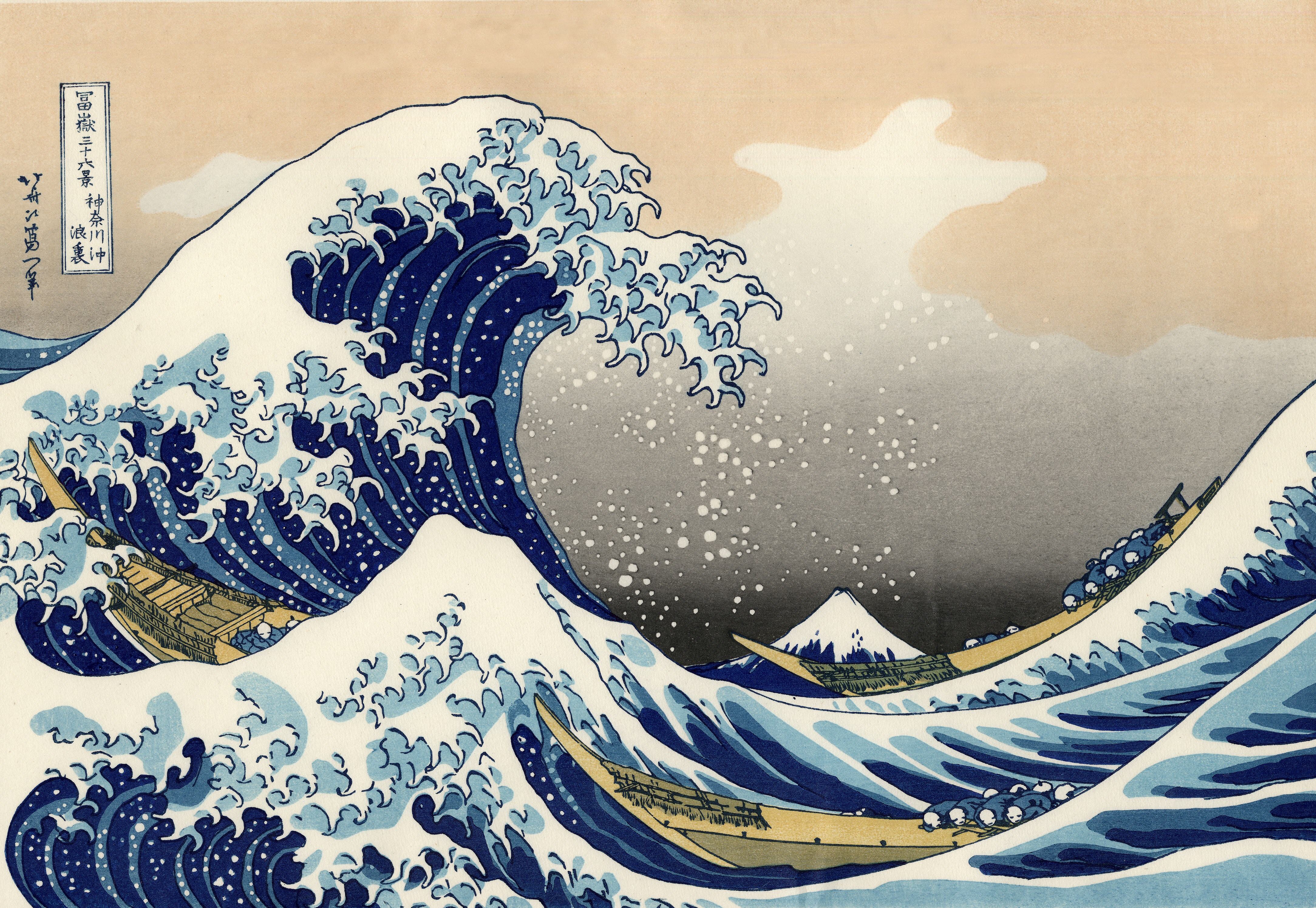
“The Great Wave of Kanagawa”, from the serie “The Thirty-six Views of Mount Fuji”, byHokusai
The Fifty-three Stations of the Tōkaidō
The Fifty-Three Stations of the Tōkaidō (東海道五十三次 Tōkaidō Gojūsan-tsugi), in the Hōeidō edition (1833–1834), is a series of ukiyo-e woodcut prints created by Utagawa Hiroshige after his first travel along the Tōkaidō in 1832.
The Tōkaidō road, linking the shōgun’s capital, Edo, to the imperial one, Kyōto, was the main travel and transport artery of old Japan. It is also the most important of the “Five Roads” (Gokaidō)—the five major roads of Japan created or developed during the Edo period to further strengthen the control of the central shogunate administration over the whole country.
Even though the Hōeidō edition is by far the best known, The Fifty-Three Stations of the Tōkaidō was such a popular subject that it led Hiroshige to create some 30 different series of woodcut prints on it, all very different one from the other by their size (ōban or chuban), their designs or even their number (some series include just a few prints).
The Hōeidō edition of the Tōkaidō is Hiroshige’s best known work, and the best sold ever ukiyo-e Japanese prints. Coming just after Hokusai’s Thirty-six Views of Mount Fuji series, it established this new major theme of ukiyo-e, the landscape print, or fūkei-ga, with a special focus on “famous views” (meisho). These landscape prints took full advantage of the new possibilities offered by the Western representation of perspective, that Japanese artists had by now fully assimilated. Hiroshige’s series met with full success, not only in Japan, but later in Western countries.
Hiroshige and the Tōkaidō
In 1832, Hiroshige traveled the length of the Tōkaidō from Edo to Kyoto, as part of an official delegation transporting horses that were to be presented to the imperial court. The horses were a symbolic gift from the shōgun, presented annually in recognition of the emperor’s divine status.
The landscapes of the journey made a profound impression on the artist, and he created numerous sketches during the course of the trip, as well as his return to Edo via the same route. After his arrival at home, he immediately began work on the first prints from The Fifty-Three Stations of the Tōkaidō. Eventually, he would produce 55 prints in the whole series: one for each station, plus one apiece for the starting and ending points.
The first of the prints in the series was published jointly by the publishing houses of Hōeidō and Senkakudō, with the former handling all subsequent releases on its own. Woodcuts of this style commonly sold as new for between 12 and 16 copper coins apiece, approximately the same price as a pair of straw sandals or a bowl of soup. The runaway success of The Fifty-Three Stations of the Tōkaidō established Hiroshige as the most prominent and successful printmaker of the Tokugawa era.
Hiroshige followed up on this series with The Sixty-nine Stations of the Kiso Kaidō in cooperation with Keisai Eisen, documenting each of the post stations of the Nakasendō (which was alternatively referred to as the Kiso Kaidō).
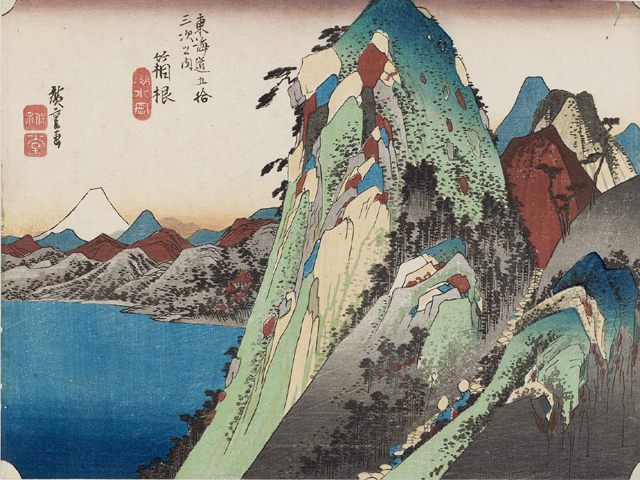
First impression, made by Hoei-Do Editor, of woodblock “Hakone”, from the serie “The Fifty-three Stations of the Tōkaidō”, by Ando Hiroshige
Master Jinsai and the work “The Fifty-three Stations of the Tōkaidō”
A story has been handed down concerning the acquisition of The Fifty-three Stations on the Tokaido, a famous series of landscape scenes by Ando Hiroshige (1797-1858), the renowned ukiyo-e master who revived that genre in the early nineteenth century. It happened that Honda, a dealer who specialized in woodblock prints, took some of Hiroshige’s works to Okada. Okada had long wanted to acquire a first-impression set of this series released by Hoeido, the original publisher, and he told Honda that if a first-impression set turned up, he would buy it on the spot. But woodblock print collectors treasured their Hoeido editions and would not easily let them go. Later reissues could be had, but first impressions were an entirely different matter, a question of sheer luck. Even Honda, who had been dealing in woodblock prints for forty years, had never seen a first-impression set of that series. Honda acknowledged Okada’s request evasively and returned home.
That very night, however, someone brought Honda one of the supposedly unavailable first-impression sets. Moreover, the person who brought him the set was a dealer in secondhand chests and mirrors who ordinarily had nothing to do with ukiyo-e. Honda was flabbergasted. He delivered the set to Okada the next day.
True art treasures are not acquired simply by handing out money. One must love art deeply and have an inner urge to acquire it. To assemble a collection also requires great luck. That Okada was able to attract outstanding artworks without becoming involved in competition suggests something mysterious.
Dr. Muneshige Narazaki, an eminent ukiyo-e scholar, commented on Okada’s extraordinary collection: “The achievement of building a collection reflects the collector’s stature. In this sense, Mr. Okada’s personality is seen in the large number of famous works he was able to bring together. Just as he loved people, he must have loved art. Moreover, that he could assemble such a collection in such a short time suggests how people were drawn by his character and took their artworks to him. To be sure, it is a very rare collection.”
See below the images of The Fifty-three Stations of the Tōkaidō, by Hiroshige!


