
THE HISTORY AND GEOGRAPHY OF ATAMI
Atami, a resort town in eastern Shizuoka Prefecture, nestles on the eastern seacoast of the neck of the Izu Peninsula. Volcanic activity in the Fuji Volcanic Zone created the Izu Peninsula, and the downtown area of Atami happens to have been built in the crater of an extinct volcano. Surrounded by mountains on the south, west, and north, the city is open only on the east, along a steep slope down to Sagami Bay. Possessed of a fascinating coastline and numerous hot springs, Atami’s climate is rather warm and mild.
Many ancient burial mounds, settlements, and vestiges of ritual sites, thought to be more than ten thousand years old, have recently been discovered in various parts of the lzu Peninsula. Ritual sites are valuable to archaeologists, for they are evidence of ancient humanity’s efforts to worship the gods they believed to inhabit certain mountains, stones, and trees.
Hot springs too have a relationship to ancient religion since they also were deified and worshiped. For instance, the Sōtōsan-engi, an ancient collection of legends about the origins of hot springs, states that in the time of Emperor Nintoku (reigned 313-99) a divine being who helped people by creating hot springs descended from heaven and appeared in Atami to save the people. It is generally believed that the name Atami (literally, “hot sea”) derives from a legend that dates from the time of Emperor Ninken (reigned 488-98) and says that in ancient times hot water sprang up from the bottom of the sea, killing shellfish and fish.
Another story tells of a priest named Mangan in the middle of the eighth century who lived at Hakone Kōngō Ōin, a temple affiliated with the shrine Hakone Gongen. Mangan thought that a hot spring in the sea was a waste and felt pity for the fish and shellfish that were being killed by the hot water. He prayed to Bhaishajya-guru, the Buddha of Healing, asking that the hot spring be moved from the sea to the mountainside, and this is said to be the origin of the hot springs in the Atami region.
In the Edo period (1615-1868) regional development centered on areas where hot springs were located. During the Meiji era (1868-1912), the hot springs of Atami became resorts for ranking officials of the Meiji government, famous politicians, wealthy businessmen, and such renowned writers as Shōyō Tsubouchi.
Out of their love of the beautiful surroundings, many artists came to build villas and work in Atami after World War II. Among them were the writers Jun’ichirō Tanizaki and Eiji Yoshikawa; the poet Nobutsuna Sasaki, who was also known for his expertise in classical Japanese literature; and the painters Taikan Yokoyama and Sōtarō Yasui.
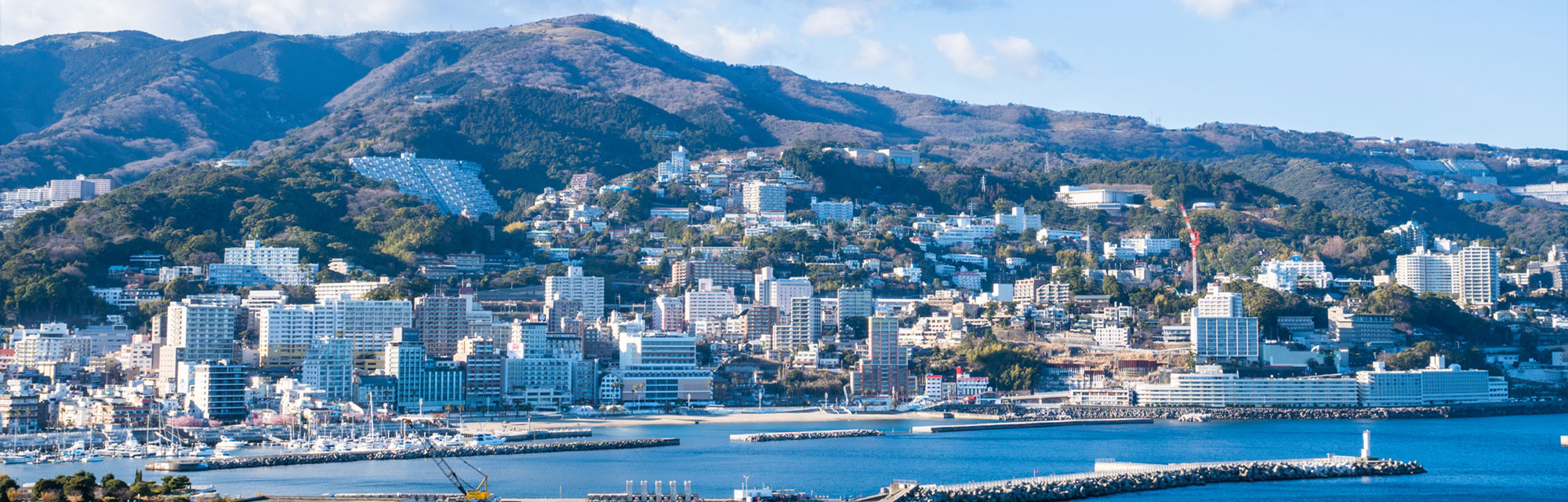
General view of the city of Atami, in Shizuoka, Japan
ZUIUN-KYO (THE HEAVENLY GROUND) – THE PROTOTYPE OF ATAMI
The construction of the Zuiun-kyo Grounds in Atami began with the 1945 purchase of four acres of land where the Hall of Worship now stands. At that time the site was known as Izu-san, Okubo Aza. A parcel of about two and a half acres near the present-day Crystal House, plum garden, and dormitory Shinjin-ryo was bought in 1946. With that purchase, the Zuiun-kyo Grounds were virtually complete. The area offered a magnificent view from the Izu Peninsula across Sagami Bay to the islands Oshima and Hatsushima and all the way to the Miura and Boso peninsulas. It was near major transportation systems, the climate was mild, and there were numerous hot springs. In every way conditions were ideal. ” Indeed ” – Master Jinsai wrote – ” these Sacred Grounds were prepared when God created the Universe. If they are not God´s great work of art, then what are they? “
In the following poem we can see Master´s idea:
“For an earthly paradise
That I am trying to make,
I have chosen
Atami with its excellent view
Of the mountains and the sea.”
Construction began at Atami in 1946. Where the dormitory Shinjin-ryo now stands, land was cleared for a caretaker´s hut. Then the sites were prepared for the Hall of Worship, Crystal House, and lower-level bus parkint lot. Unlike Hakone, which is small and relatively level, the property in Atami is extensive and the ground was uneven, necessitating much excavation.
As wich the construction at Hakone, work at the Zuiun-kyo Grounds was aided by miracles, and the necessary materials, neither too much nor too little, appeared at the right time, as if from nowhere. Regarding those miracles, Master Jinsai told in a poem:
“The deep plan of God
Has become evident
At Hakone and Atami,
Where we have
Come to understand it.”
The last building at Zuiun-kyo that Master Okada himself designed, and the last one he saw completed, was the Crystal House. One of his verses about Zuiun-kyo reads:
“Like a picture scroll,
Unrolling
Before your eyes
Is the fascinating scenery
From Keikan-dai”
Keikan-dai is the name Master Jinsai gave the terrace with the best view within the Zuiun-kyo Grounds. There the Crystal House was built. When it was completed, in December 1954, the Crystal House created a sensation in architetural circles. With concentrated work and the dedicated efforts of devout followers from all over the country, the Crystal House was completed in just three months.
CONSTRUCTIONS OF ZUIUN-KYO
Kyusei Kaikan (The Hall of Worship) – The present Hall of Worship was reconstructed in April 1972. Previously at the same site, there was a hall which was designed personally by Meishu-Sama. The exterior of the new hall was designed to express Meishu-Sama´s conception of the old hall, which had vertical stripes in white and grey, by creating a similar effect with the reflection of a row of columns against a white wall. The zuiun design os auspicious clouds is engraved on the large aluminum die cast wall and also on each of the forty-two fifteen-meter high columns. The whole building is about 12,000 square meters and has 3,456 seats in the main auditorium on the third and fourth floors. Including its spacious conference rooms, the hall can seat 6,000 persons – twice the capacity of the old hall.
Kyusei Atami Bijutsu-kan (The Kyusei Atami Art Museum) – The Atami Art Museum was established within the old Hall of Worship in 1957, as an accompaniment to the Hakone Art Museum. The museum was temporarily closed during the reconstruction of the hall and reopened again upon completion of the new Hall of Worship. Combining man-made beauty and the natural beauty of the area, a new museum and garden are now under construction on Hoodai, a hill overlooking the Zuiun-kyo. It will be completed in 1982 to commemorate the centenal anniversary of the birth of Meishu-Sama, founder of World Messianity. The art collection of calligraphies, paintings, sculpture, and ceramics consists mostly of items chosen personally by Meishu-Sama. The collection contains nearly 2,000 items including such Japanese national treasures as the Red and White Plum Screen by Korin, the Wisteria Jar by Ninsei, and the Kanboku-jo, a collection of poetry.
Suisho-den and Tsutsuji-yama (The Crystal House and Azalea Hill) – This building was designed by Meishu-Sama. The name “Crystal House” is derived from Meishu-Sama´s idea of Paradise on Earth as a crystal world, free from clouds. Using a cantilever structure, Meishu-Sama removed pillars from the structure to give an unobstructed view of the beautiful Pacific Ocean. This building is used mainly as a reception hall for guests. In front of the Crystal House is a gently sloping hill of about 3,000 square meters covered with 3,600 azaleas. The azaleas are in full bloom from late April through early May. More and more people come every year to enjoy the beautiful array of colors, making this one of the most scenic spots of Atami.
Kyusei Shinden (The Holy Sanctuary) – The Holy Sanctuary was completed in October 1961 under the direction of Nidai-Sama, who succeeded the spiritual leadership of the church in 1955. It is dedicated to the Great God of Light. The solemn and graceful Holy Sanctuary is built in the irimoya style, with split gables; the roof is covered with copper sheets. The exterior is covered with granite and the interior is finished with Japanese cypress; it is a sanctuary with modern brightness and a quiet purity.
Inazuma Kaidan (Lightning Stairs) – This is a stone stairway leading to the main entrance of the Hall of Worship. It is named after the zig-zag shape of lightning. This was also Meishu-Sama´s design. Each of the openings on the handrail of the stairway is off a differente size, but they fit naturally with the number of stairs and landings. The white stone gives a refreshing feeling of brightness and purity. Meishu-Sama gave carefull thought to the width and height of the stairs to provide easy walking for people of all ages.
Baien (Plum garden) – The plum garden can be appreciated from above of below. Meishu-Sama enjoyed the paintings of Ogata Korin very much and He fashioned this garden in the style of Korin. The garden consists of undulating hills with small paths meandering through various species of plum trees. There are 360 trees, some of which are over one hundred years old. Meishu-Sama instructed His workers, “Plum trees which bloom beautifully have no fragrance, so only plant trees which bear fruit for they have a sweet fragrance“. Thanks to the devoted care of servers, the older trees bloom beautifully every year.


