
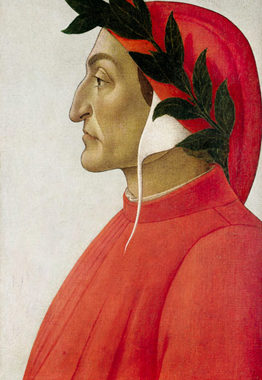
Durante di Alighiero degli Alighieri (Italian: [duˈrante deʎʎ aliˈɡjɛːri]; Latin: Dantes), commonly known by his pen name Dante Alighieri or simply as Dante (/ˈdɑːnteɪ, ˈdænteɪ, ˈdænti/,also US: /ˈdɑːnti/, Italian: [ˈdante]; c. 1265 – 1321), was an Italian poet during the Late Middle Ages. His Divine Comedy, originally called Comedìa (modern Italian: Commedia) and later christened Divina by Giovanni Boccaccio, is widely considered the most important poem of the Middle Ages and the greatest literary work in the Italian language
In the late Middle Ages, most poetry was written in Latin, making it accessible only to the most educated readers. In De vulgari eloquentia (On Eloquence in the Vernacular), however, Dante defended the use of the vernacular in literature. He would even write in the Tuscan dialect for works such as The New Life (1295) and the Divine Comedy; this highly unorthodox choice set a precedent that important later Italian writers such as Petrarch and Boccaccio would follow.
Dante was instrumental in establishing the literature of Italy, and his depictions of Hell, Purgatory and Heaven provided inspiration for the larger body of Western art. He is cited as an influence on John Milton, Geoffrey Chaucer and Alfred Tennyson, among many others. In addition, the first use of the interlocking three-line rhyme scheme, or the terza rima, is attributed to him. In Italy, he is often referred to as il Sommo Poeta (“the Supreme Poet”) and il Poeta; he, Petrarch, and Boccaccio are also called “the three fountains” or “the three crowns”.
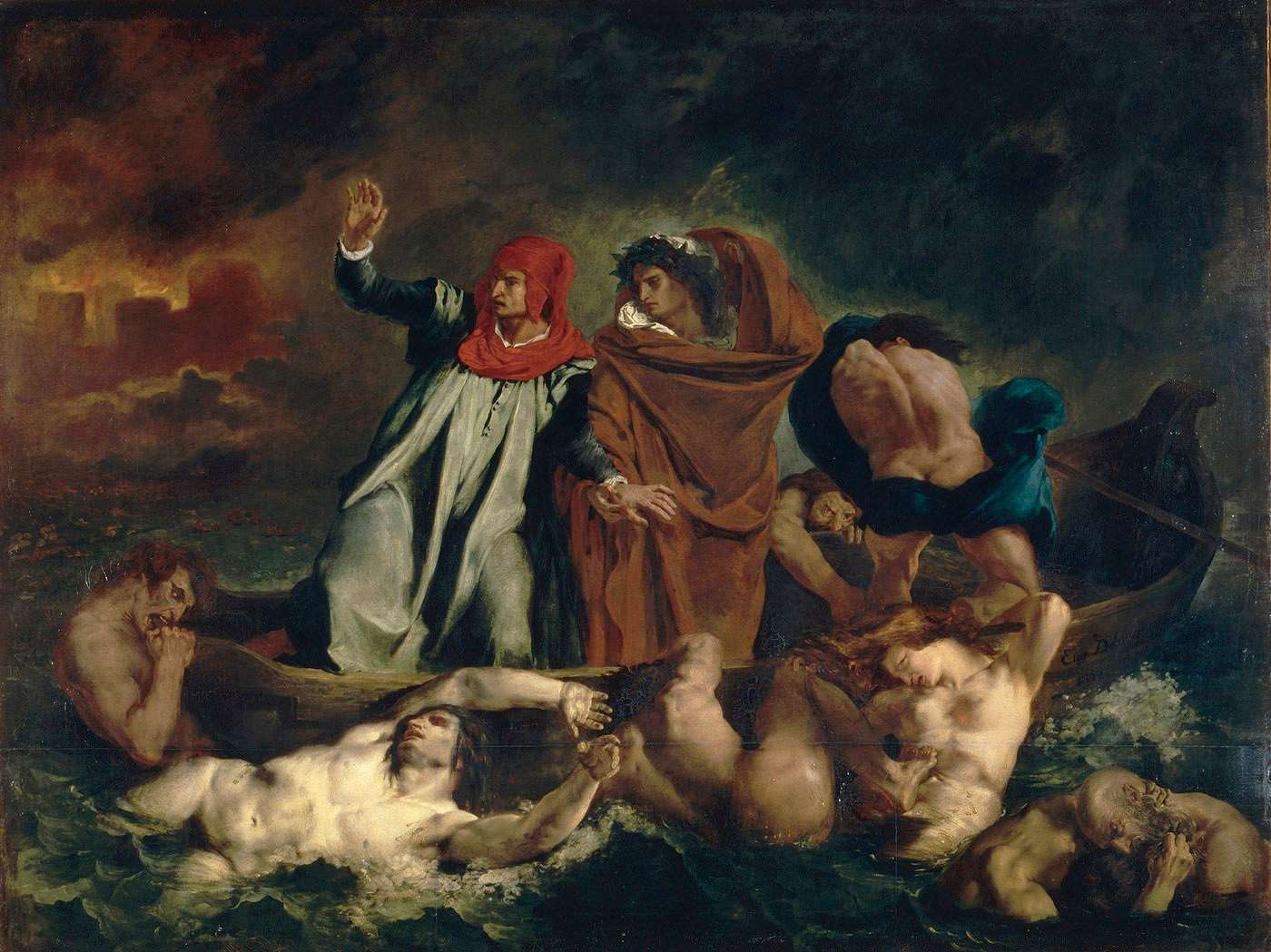
Dante and Virgilio in hell
By Eugène Delacroix, Louvre Museum
The Divine Comedy
The Divine Comedy describes Dante’s journey through Hell (Inferno), Purgatory (Purgatorio), and Paradise (Paradiso); he is first guided by the Roman poet Virgil and then by Beatrice, the subject of his love (and of another of his works, La Vita Nuova). Of the books, Purgatorio is arguably the most lyrical of the three, referring to more contemporary poets and artists than Inferno; Paradiso is the most heavily theological, and the one in which, many scholars have argued, the Divine Comedy’s most beautiful and mystic passages appear (e.g., when Dante looks into the face of God: “all’alta fantasia qui mancò possa”—”at this high moment, ability failed my capacity to describe,” Paradiso, XXXIII, 142).
New readers often wonder how such a serious work may be called a “comedy”. In the classical sense the word comedy refers to works which reflect belief in an ordered universe, in which events tend toward not only a happy or amusing ending but one influenced by a Providential will that orders all things to an ultimate good. By this meaning of the word, as Dante himself wrote in a letter to Cangrande I della Scala, the progression of the pilgrimage from Hell to Paradise is the paradigmatic expression of comedy, since the work begins with the pilgrim’s moral confusion and ends with the vision of God.
Read here Master Jinsai’s Teaching about Dante Alighieri!