
THE HAKONE ART MUSEUM
In a corner of the Hakone Shinsen-kyo above Mountain-view Lodge stood a tiny straw-thatched cottage that Okada called Bird House. It had been one of the summer cottages for rent on the property before Okada bought it. For several years it served as a lounge for members who came to meet Okada, but after Sunshine Hall was completed, in 1948, Bird House was rarely used. It was eventually decided to demolish the building, which was getting very old. At that time, toward the end of 1950, there were plans to build a headquarters for the Taisei-dai Church near the Shinsen-kyo Grounds and to use salvageable material from Bird House in the construction.
Bird House was almost one hundred square meters in area, but after it was dismantled people realized that the plot on which it had stood was larger than they had thought. Okada decided to build an art museum on the land. Later he wrote: “The cottage had stood on a plot of about five hundred square meters, and I was thinking about what I might put there. The idea of an art museum came to mind. Yes, that was it! For an art museum it was a bit small, but the location and surroundings were perfect. I immediately made up my mind. Even if we were to construct a small art museum, however, it would not be easy to raise the money for it. There seemed little prospect of finding a large sum in the immediate future, but at least we could prepare a site for that purpose. Then someday the time to build it would probably come. So work was started to prepare the plot. It was just about ready last summer [1951]. Having gone that far, I felt that I simply had to press on and put up the building as soon as possible. I talked with Abe [Okada’ s assistant at the time], and he said he would look into it immediately. He did so and reported that the prospects were not hopeless. I was sure that God would help us in one way or another, and in October I moved ahead with preparations for the construction.”
Okada’s plans called for a three-story building with about eight hundred and eighty square meters of floor space. It was to be a neat white-stucco building with a Chinese-style, blue-tile roof. The first and second floors were to have three display galleries each, and the third floor was to consist of two Japanese-style rooms. The structure was designed by Okada himself.
Construction began in October 1951, and work proceeded at an amazing pace. By the middle of November the foundation and the framework were completed. In December the concrete for the reinforced walls and floors was being poured. While the concrete was being poured for the second floor, work continued twenty-four hours a day. Of the members who had gathered from all over the country to help with the construction, the most robust men were chosen for the project, and a task that common sense said was impossible moved ahead on the power of faith. The people involved in the construction were continually surprised by their own accomplishments. By early March 1952, the exterior was finished and work on the interior had begun.
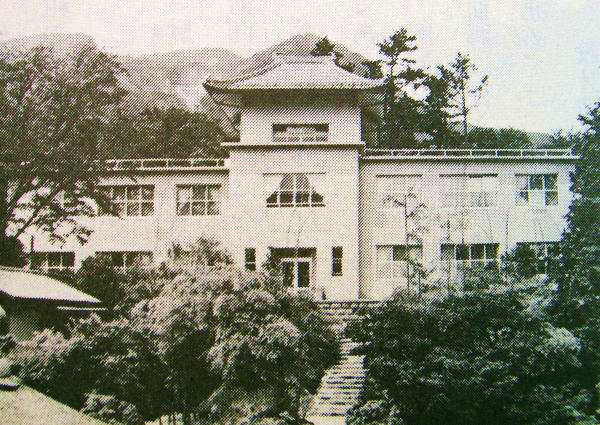
External view of Hakone Art Museum at the time of the opening
In the autumn of 1951, Okada moved to Atami for the winter, as had become his custom. But several times a month he went by car across Jukkoku-toge to the Shinsen-kyo to observe the progress of the construction. With a jaunty step he would move about, stopping here and there to give detailed instructions on various points. For example, when the display-gallery doorways were being built, he said that the dimensions in the plans were too large. He wanted the doorways made smaller. One door frame was built according to the plans, and he had it put in place. He walked through it several times to test it, and the dimensions were revised. Okada also gave particular care and attention to the curvature of the roof and to the color of the roof tiles. For the roof tiles, he looked at many samples before deciding on a shade that he liked. Then a special order was placed to have tiles of that particular color fired.
The greatest care was taken with the Japanese-style rooms on the third floor, which were intended for the reception of special guests. For instance, because the window on the eastern side, facing Myojogatake, did not seem suitable with bare glass and simple rain shutters alone, shoji panels of translucent paper were installed inside the room against the window in order to soften the room’s atmosphere. A series of models including the shoji were made, and the thickness of the latticework members and their spacing were studied to achieve an overall harmony within the room. Paulownia wood was chosen for the recessed panels of the ceiling, and a checkerboard pattern in silver and gold was selected for the sliding doors. A small terrace on the eastern side of the building was planted with bamboo so that Myojogatake could be viewed through bamboo leaves. Everything was thought out to the last detail. The cloud pattern carved as fretwork in the transoms was done from a preparatory sketch that Okada made. That drawing, which depicted an auspicious cloud (zuiun), was later used as the pattern for the stage curtain in the Hall of Worship in Atami.
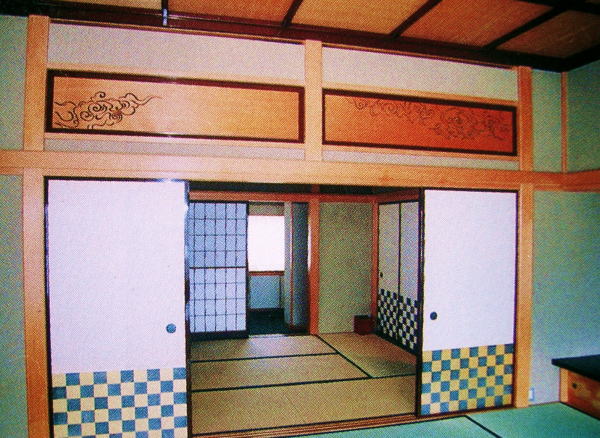
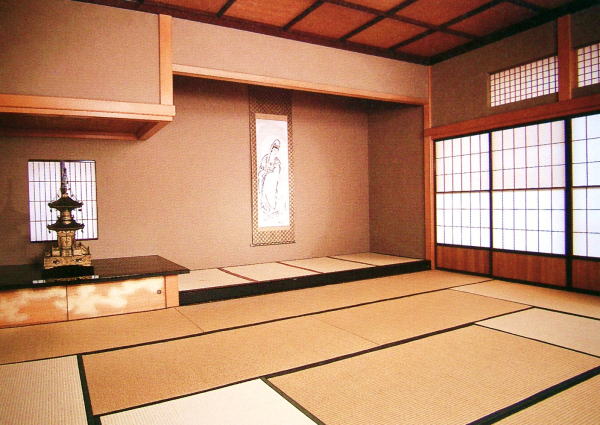
Second-floor Japanese rooms in the Hakone Art Museum
Okada’s painstaking inspections of the construction site stimulated progress. The attention to detail and the meticulous concern for future visitors that were evident in his instructions increased the volunteer worker’s motivation. They learned about the true love that spiritual work involves and experienced a reawakening of faith. As he walked about the site, volunteer workers would stop their labors and greet him. In reply, he would tip his hat and make an informal comment. To put them at ease, he would sometimes ask the volunteers where they came from or how long they had been donating their services. He did this unaffectedly. His words were simple. But for the members doing volunteer work, it was an unnerving experience, and they found it difficult to answer without sounding confused. After giving some incoherent reply, they would realize the greatness of his love and be filled with emotion.
Regulations issued in 1951 with SCAP’ s approval placed restrictions on the construction of large buildings. Those regulations increased the urgency of the construction work, because buildings whose roofs were completed by a certain date were exempted from compliance. In order to meet that deadline, there were many all-night concrete-pouring sessions in November and December. A full day of heavy labor was demanding, but the burden was enormous when night shifts were added. Yet even the women volunteers – who usually took care of the kitchen duties – participated of their own accord, carrying sand and gravel and helping with the concrete mixing. God seemed to respond to the volunteer’s dedication. Winter nights in the mountains, especially after clear sunny days, feel particularly cold. Mysteriously, though, when night shifts were scheduled the weather would be cloudy and mild. Directly feeling divine protection, the people applied themselves to their work with joy, forging ahead step by step with their sacred task.
By May 1952, when Okada moved from Atami back to Hakone, the museum was almost complete. Against the background of Soun-zan, clad in the glory of spring green, the clean, fresh shape of the building seemed to float in the air. Every day Okada went to the site and, ignoring the wood shavings scattered about, inspected the work thoroughly, scrutinizing everything. From the time construction started, his talks at meetings with members turned more and more toward topics concerning art. He would say that the Hakone Museum of Art was a sanctuary for beauty to introduce Japanese art to the world. He predicted that when completed it would become known overseas and that many people from around the world would surely visit the museum.
At a time when even the government was unable to stem the exodus of the nation’s artworks overseas, Okada’s pioneering efforts to protect traditional Japanese art and his idea of making outstanding artworks available to the public and of helping people both at home and abroad discover the worth of Japanese culture served to stimulate the artistic consciousness of the church’s members. Concerning the museum’s spiritual significance, he made such comments as “You see, the art museum is a prototype in God’s work” and “The art museum is a symbol of paradise on earth.” With the completion of the museum, the Hakone Shinsen-kyo would be complete as a miniature paradise, he explained, and in time this prototype would be reflected on a larger scale in the worldwide construction of paradise. Hearing him speak of the museum’s significance deepened his followers’ realization that they had been allowed to participate in God’s work at the highest level, and they felt a surge of pride and joy.
Okada wrote unique calligraphic scrolls to give as tokens of appreciation to followers who had made special contributions to the construction of the museum. He prepared more than thirty of them, in the style of a tea-ceremony scroll, with a single vertical line of calligraphic text. Usually he did his calligraphy with one quick burst of energy, but for these scrolls he took time with his task and wrote a different text on each.
OPENING
The museum building was completed on June 10, 1952. On that day display cases were installed, and on the eleventh the arranging of exhibits in the cases began. Okada stayed at the museum all day, arranging artworks and looking after other details, including even the placement of explanatory labels. Art dealers also came to help with the displays. As objects were brought out one by one, the dealers would notice well-known items that had been rumored to be for sale and would comment in surprise. They bantered with Okada as they worked together on the exhibits.
On June fourteenth, the day before its opening, Okada was at the museum checking everything carefully until after eight in the evening, missing his supper. He would take a piece carefully in both hands and painstakingly shift its position or otherwise adjust the display. His overflowing joy at finally realizing his long-held dream was very apparent.
When he was satisfied with the displays, he returned to Mountain-view Lodge. That night, around eleven, he took Yoshi back to the museum. In the brightly lighted cases, many of the rare works he had collected were impressively arranged. Forgetting the lateness of the hour, he peered at each mute object, as if speaking with it. By the time he had made the rounds of the museum, it was almost one in the morning. As he looked back again and again while leaving, the museum attendant who accompanied him realized how anxiously Okada had been waiting for the museum opening and how overcome he was with joy now that the museum was completed.
Three days of services to commemorate the completion of the museum and of a prototype of paradise on earth began on June 15, 1952. The Hakone Museum of Art was a focus of the Hakone Sacred Grounds, and the museum’s opening marked a stage of completion of the prototype in Hakone. For the occasion Okada composed eighteen poems, these among them:
In accordance with God’s plan,
The land of the rising sun
Has been designated a nation of beauty.
Let us never forget
This important point.
I have constructed
In beautiful Hakone
A sanctuary for art
Whose loveliness helps cleanse
Our polluted, unclean world.
In order to make
A world of
Truth, virtue, and beauty,
I have taken on the task
Of manifesting divine strength.
During those three days, the eighteen poems written by Okada were recited enthusiastically by the thousands of followers who gathered for the worship services. Each day, Okada spoke about the significance of the completion of the museum and about the will of God as embodied in the museum’s establishment. His cheerful, energetic remarks were evidence of his joy and suggested unprecedented development of the church in the future. When the services ended, members visited the new museum and, with obvious delight, viewed the works on display. Okada’s consideration is seen in his decision to open the museum to members before admitting the general public: it was the members’ dedication to his goal that had brought Okada’s vision to fruition, and in recognition of their achievement he wished to let the members savor the joy of success first.

Two weeks later, from June twenty-ninth through July first, well-known people from the press, the government, and the fine arts, as well as people of local importance, were invited to the museum. Visitors on the first day, June twenty-ninth, included both local dignitaries from Atami, Hakone, and Odawara and people connected with the Japan Religions League and the Union of the New Religious Organizations in Japan.
Writers, artists, entertainers, and the press were invited to visit the museum on June thirtieth. The writers who came included Yasunari Kawabata, Jun Takami, Fumio Niwa, and Nobuko Yoshiya. Among the artists and entertainers were the calligrapher Saishu Onoe; the sculptor Denchu Hiragushi; Gonroku Matsuda, a maki-e lacquer craftsman; the painters Tatsushiro Takabatake, Shigetaro Fukushima, Ryushi Kawabata, and Kazumasa Nakagawa; the shamisen player Eizo Kineya; and Michio Ito, a choreographer. The radio entertainer Musei Tokugawa also attended. Other notable guests included the architect Isoya Yoshida and Tetsuzo Tanikawa, dean of the faculty of letters (and later president) of Hosei University, who was also an art critic. From the press and the publishing industry came Mosaku Sasaki, president of Bungei Shunju Company; the editor in chief of the newspaper Mainichi Shimbun; the editor in chief of the newspaper Tokyo Nichinichi Shimbun; and the editor in chief of the newspaper San Shashin Shimbun. Members of the Cultural Properties Special Review Committee also attended, helping make the occasion memorable. An old friend from Okada’s years as a businessman, Kojiro Matsuda, owner of the Ginza store Hakubotan, was also present.
Representatives of the foreign diplomatic corps and people in the fine arts were invited to visit the museum on the final day, July first. Vincenzo Solo, counselor at the Italian embassy, members of an art society, and several staff members from the national museums attended. Diet member Ino Dan was present, and Gyoin Hashimoto, abbot of the temple Yakushi-ji, was represented by the present abbot, Koin Takada.
The invitations sent to these people were issued in Okada’s name as director of the Hakone Museum of Art. One guest who received an invitation, Musei Tokugawa, said that when he saw “Mokichi Okada, Director of the Hakone Museum of Art” – instead of “Mokichi Okada, Spiritual Leader of Sekai Meshiya Kyo” – he discerned in the use of that title an innocent, childlike expression of Okada’s deep joy.
Okada formally greeted the guests who came on July first and spoke about the significance of the museum’s construction. The construction of the Sacred Grounds and the establishment of the museum were discussed as a cultural undertaking. Throughout world history, both East and West, religion has given birth to art. The original ideal of religion is to make a world of beauty that also embraces truth and virtue. Japan’s mission is to bring joy to people around the world through the medium of beauty. In this way, Okada said, Japan might contribute to the promotion of artistic excellence. In concluding, he explained that the small paradises at Atami and Hakone had been established with the intention of helping to achieve the mission God had given Japan to realize the original ideal of religion. Through the museum, Okada wanted to make available to everyone artworks that had previously been the exclusive property of the privileged classes so that this art might uplift the consciousness of everyone.
In response to Okada’s welcoming remarks, the writer Yoshiro Nagayo spoke on behalf of the guests. He said that amid the devastation in the wake of the war, Okada’s marvelous idea of making art readily available to masses of people and his tireless efforts in carrying out this project had filled him with admiration.
Okada served as guide that day. Drawing on the knowledge acquired through years of study, he gave detailed explanations of every object on display. Even guests who had a thorough knowledge of art were amazed at the extent of his attainments and the keen feeling with which he talked about the objects. Behind his explanations lay his abiding love of art and his personal response to beauty. His joy and enthusiasm filled the museum, and the guests spent a happy day absorbed in the appreciation of art.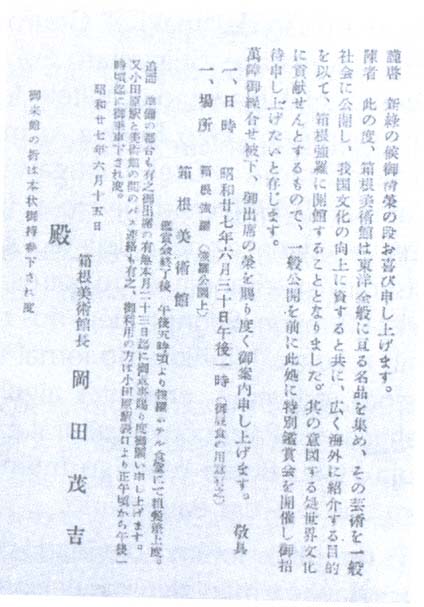
Invitation to the Hakone Art Museum Opening. Master Jinsai presents Himself as the museum director
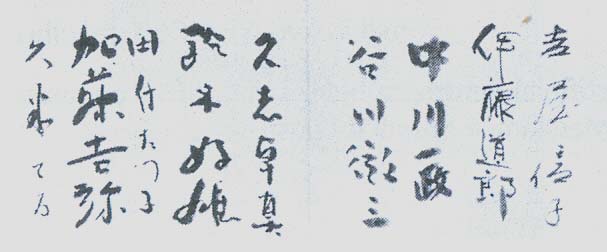
Names of invited people to the museum opening signed in the presence list
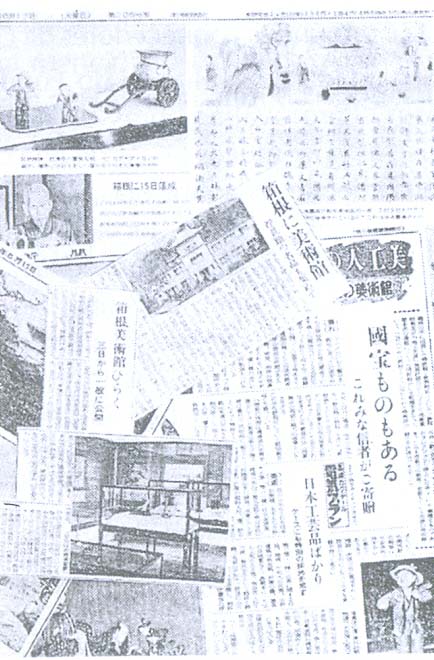
Articles noticing the Hakone Art Museum opening
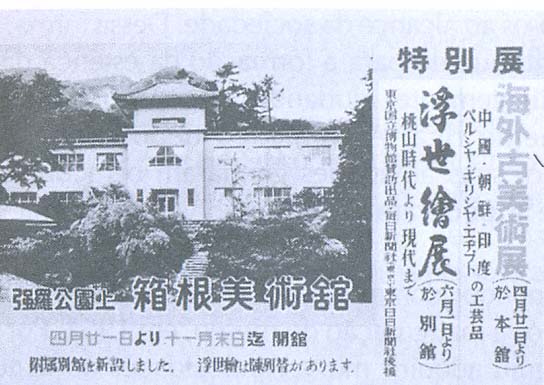
Ukiyo-e exhibition in June 1st, 1953