
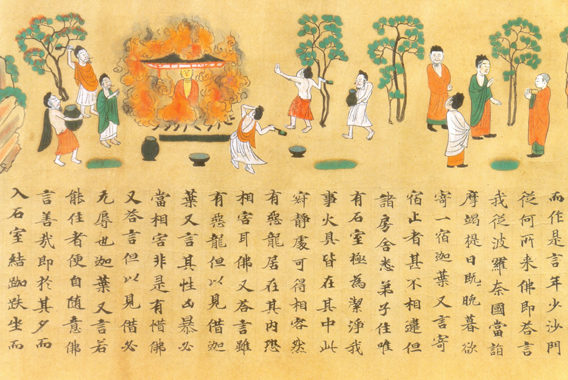
Nara period (645 – 794), Japan
Dim.: 26.7 X 154.5 cm.
The Sutra of Cause and Effect was translated into Chinese in four fascicles by the fifth-century Indian monk Gunabhadra. A biography of Shakyamuni, it describes both his former lives and his existence as the historical Buddha. In the eight-fascicle illustrated version of this sutra, pictures of important events appear above the text. This fragment begins with the eighty-fourth line (on the fourth sheet) of fascicle four, in the chapter “The First Sermon of the Buddha”, and continues to about the eighth paragraph of the chapter “The Three Enlightened Kashyapa Brothers.” It is thought that various types of transcriptions of this sutra were made in Japan on the basis of an original wood-block-printed copy of the sutra brought from China during the eighth century.
The treatment of clothing and trees and the manner of defining space by the placement of rocks and buildings are reminiscent of Chinese paintings of the Six Dynasties Period (222 – 589). However, the careful rendering of the figures and their expressions are representative of the sensitivity of Japanese painters. This is a very valuable example of Nara-period painting, of which very few examples survive.