The Japanese tea ceremony, also called the Way of Tea, is a Japanese cultural activity involving the ceremonial preparation and presentation of matcha (抹茶), powdered green tea.
In Japanese, it is called chanoyu (茶の湯) or sadō, chadō (茶道), while the manner in which it is performed, or the art of its performance, is called (o)temae ([お]手前; [お]点前). Zen Buddhism was a primary influence in the development of the Japanese tea ceremony. Much less commonly, Japanese tea practice uses leaf tea, primarily sencha, in which case it is known in Japanese as senchadō (煎茶道, the way of sencha) as opposed to chanoyu or chadō.
Tea gatherings are classified as an informal tea gathering chakai (茶会, tea gathering) and a formal tea gathering chaji (茶事, tea event). A chakai is a relatively simple course of hospitality that includes confections, thin tea, and perhaps a light meal. A chaji is a much more formal gathering, usually including a full-course kaiseki meal followed by confections, thick tea, and thin tea. A chaji can last up to four hours.
Chadō is counted as one of the three classical Japanese arts of refinement, along with kōdō for incense appreciation, and kadō for flower arrangement.
The use of Japanese tea developed as a “transformative practice”, and began to evolve its own aesthetic, in particular that of “sabi” and “wabi” principles (see Wabi-sabi). “Wabi” represents the inner, or spiritual, experiences of human lives. Its original meaning indicated quiet or sober refinement, or subdued taste “characterized by humility, restraint, simplicity, naturalism, profundity, imperfection, and asymmetry” and “emphasizes simple, unadorned objects and architectural space, and celebrates the mellow beauty that time and care impart to materials.”[9] “Sabi”, on the other hand, represents the outer, or material side of life. Originally, it meant “worn”, “weathered”, or “decayed”. Particularly among the nobility, understanding emptiness was considered the most effective means to spiritual awakening, while embracing imperfection was honoured as a healthy reminder to cherish our unpolished selves, here and now, just as we are—the first step to “satori” or enlightenment.
The tea ceremony also includes the appreciation of some elements, such as:
1 – Flower arrangement – Chabana (literally “tea flower”) is the simple style of flower arrangement used in tea rooms. Chabana has its roots in ikebana, an older style of Japanese flower arranging, which itself has roots in Shinto and Buddhism.
It evolved from the “free-form” style of ikebana called nageirebana (投げ入れ, “throw-in flowers”), which was used by early tea masters. Chabana is said, depending upon the source, to have been either developed or championed by Sen no Rikyū. He is said to have taught that chabana should give the viewer the same impression that those flowers naturally would give if they were [still] growing outdoors, in nature.
Unnatural or out-of-season materials are never used. Also, props and other devices are not used. The containers in which chabana are arranged are referred to generically as hanaire (花入れ). Chabana arrangements typically comprise few items, and little or no filler material. In the summer, when many flowering grasses are in season in Japan, however, it is seasonally appropriate to arrange a number of such flowering grasses in an airy basket-type container. Unlike ikebana (which often uses shallow, wide dishes), tall, narrow hanaire are frequently used in chabana. The containers for the flowers used in tea rooms are typically made from natural materials such as bamboo, as well as metal or ceramic, but rarely glass as Ikebana (another flower arrangement) uses short, glass vases.
Chabana arrangements are so simple that frequently no more than a single blossom is used; this blossom will invariably lean towards or face the guests.
2 – Hanging scroll – Calligraphy, mainly in the form of hanging scrolls, plays a central role in tea. Scrolls, often written by famous calligraphers or Buddhist monks, are hung in the tokonoma (scroll alcove) of the tea room. They are selected for their appropriateness for the occasion, including the season and the theme of the particular get-together. Calligraphic scrolls may feature well-known sayings, particularly those associated with Buddhism, poems, descriptions of famous places, or words or phrases associated with tea. Historian and author Haga Kōshirō points out that it is clear from the teachings of Sen no Rikyū recorded in the Nanpō roku that the suitability of any particular scroll for a tea gathering depends not only on the subject of the writing itself but also on the virtue of the writer. Further, Haga points out that Rikyū preferred to hang bokuseki (lit., “ink traces”), the calligraphy of Zen Buddhist priests, in the tea room.[17] A typical example of a hanging scroll in a tea room might have the kanji 和敬清寂 (wa-kei-sei-jaku, lit. “harmony”, “respect”, “purity”, and “tranquility”), expressing the four key principles of the Way of Tea. Some contain only a single character; in summer, 風 (kaze, lit. “wind”) would be appropriate. Hanging scrolls that feature a painting instead of calligraphy, or a combination of both, are also used. Scrolls are sometimes placed in the waiting room as well.
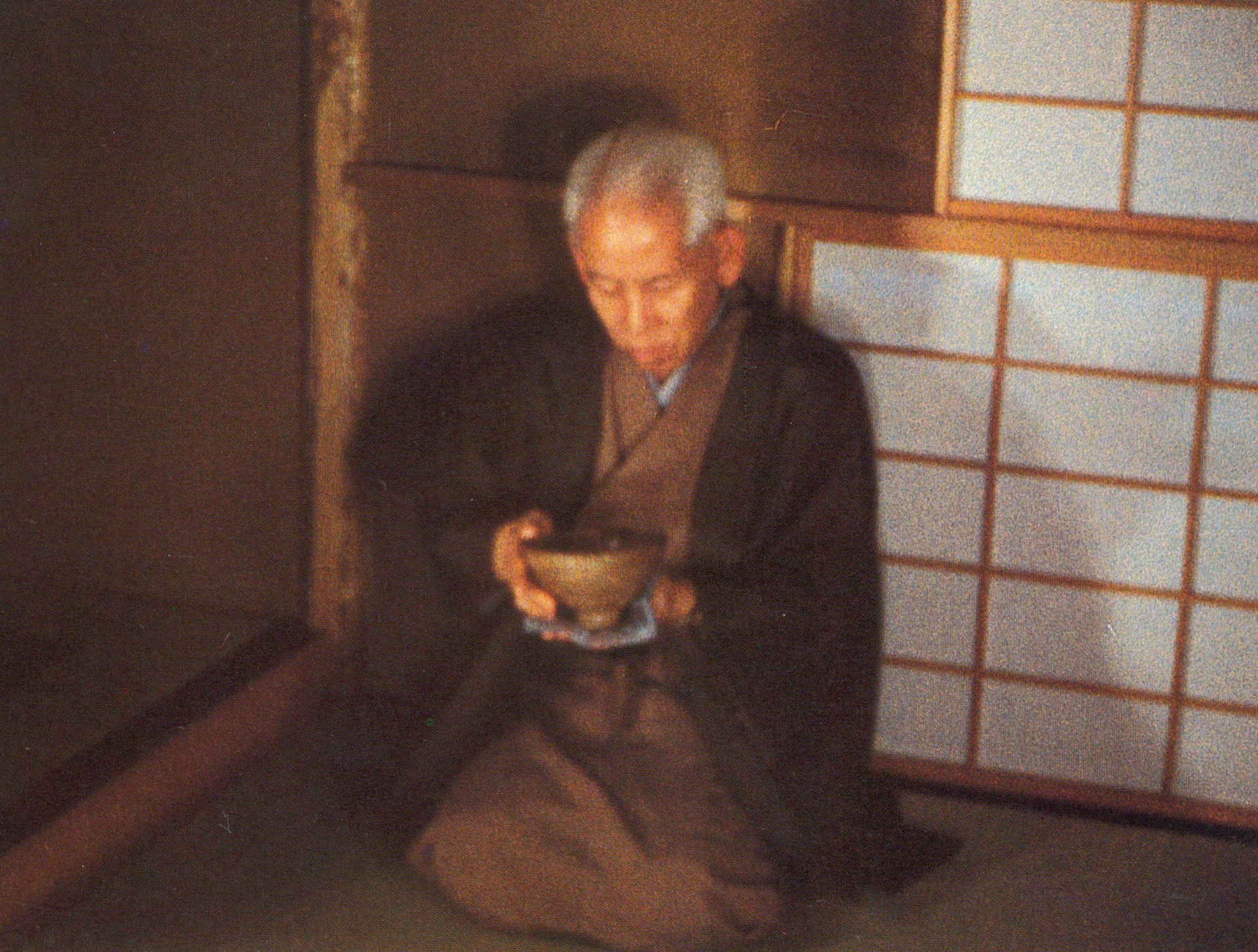
Master Jinsai enjoied tea ceremony very much. When He received people at Sangetsu-An (Mountain and Moon Tea House), in Hakone, He prepared the room personally, chosing the calligraphies to be exposed, making the flowers arrangments and guesting people with so much pleasure.
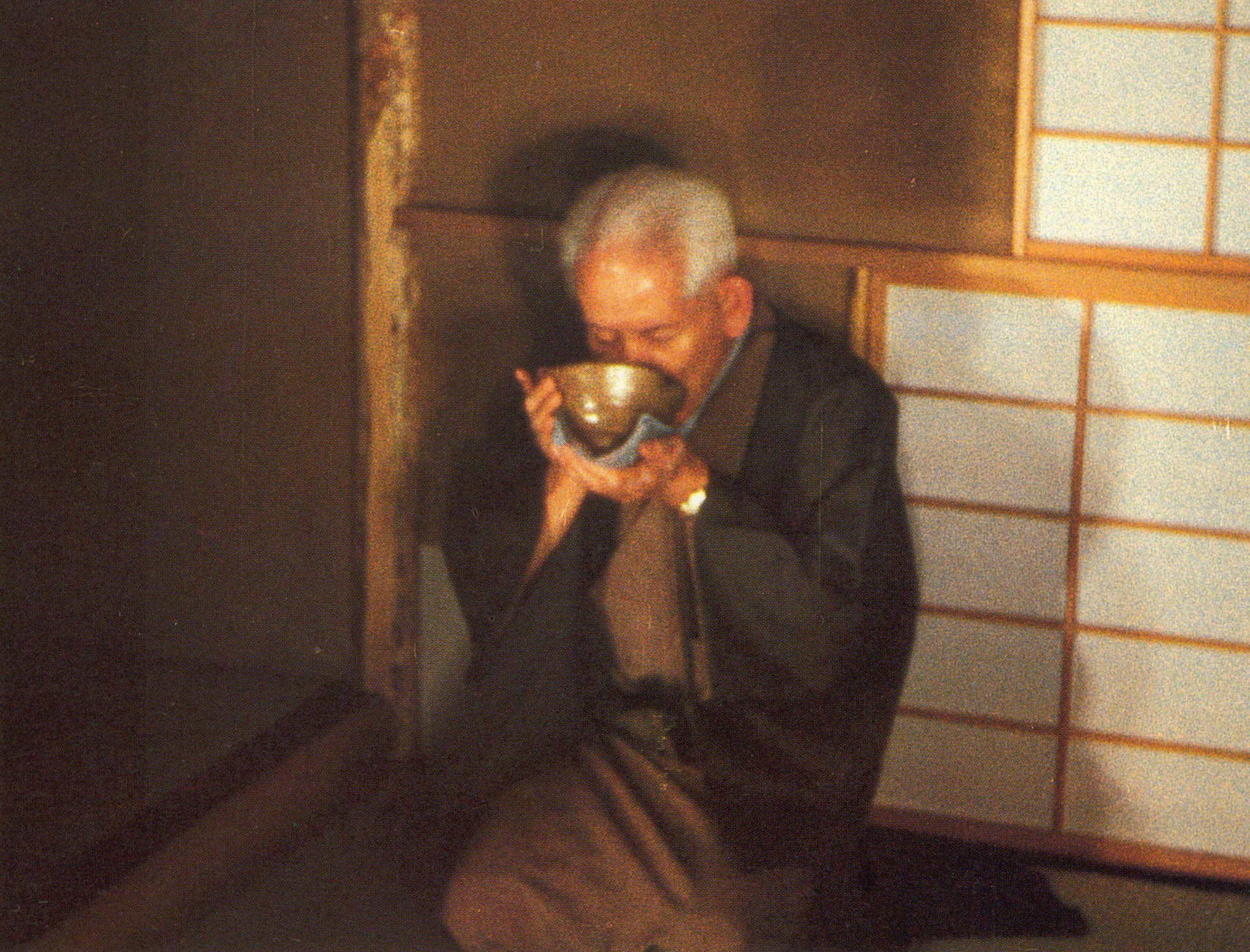
Relationship between Tea Ceremony and Zen Buddhism
The mental state of meditation Zen and of tea ceremony looks like. What in Zen is contemplation and meditation, in tea ceremony is concentration and discipline.
Sen-no-Rikyu (1522 – 1591)
Sen no Rikyū (千利休, 1522 – April 21, 1591), also known simply as Rikyū, is considered the historical figure with the most profound influence on chanoyu, the Japanese “Way of Tea”, particularly the tradition of wabi-cha. He was also the first to emphasize several key aspects of the ceremony, including rustic simplicity, directness of approach and honesty of self. Originating from the Sengoku period and the Azuchi–Momoyama period, these aspects of the tea ceremony persist. Rikyū is known by many names; for convenience this article will refer to him as Rikyū throughout.
There are three iemoto (sōke), or “head houses”, of the Japanese Way of Tea, that are directly descended from Rikyū: the Omotesenke, Urasenke, and Mushakōjisenke, all three of which are dedicated to passing forward the teachings of their mutual family founder, Rikyū.
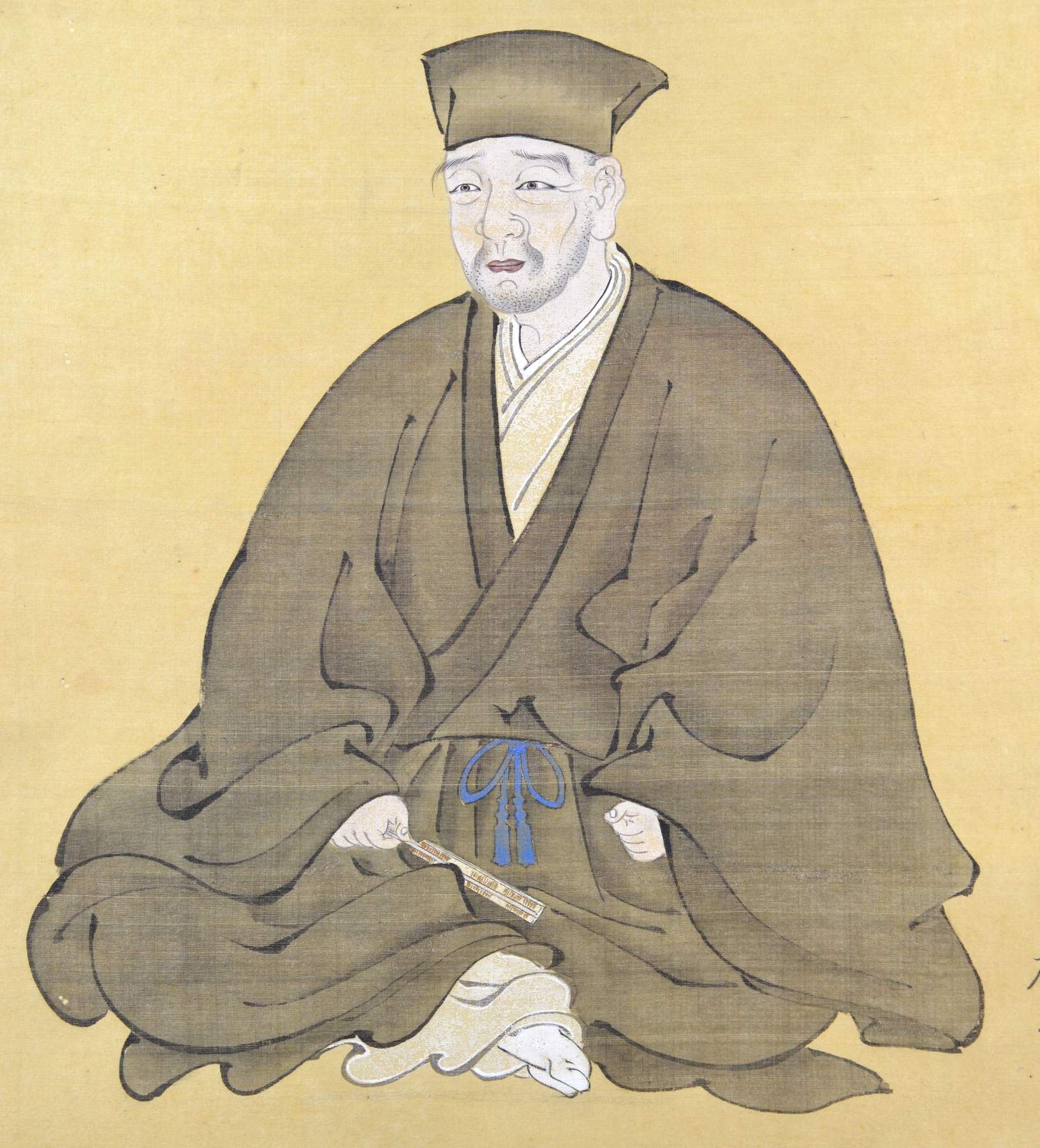
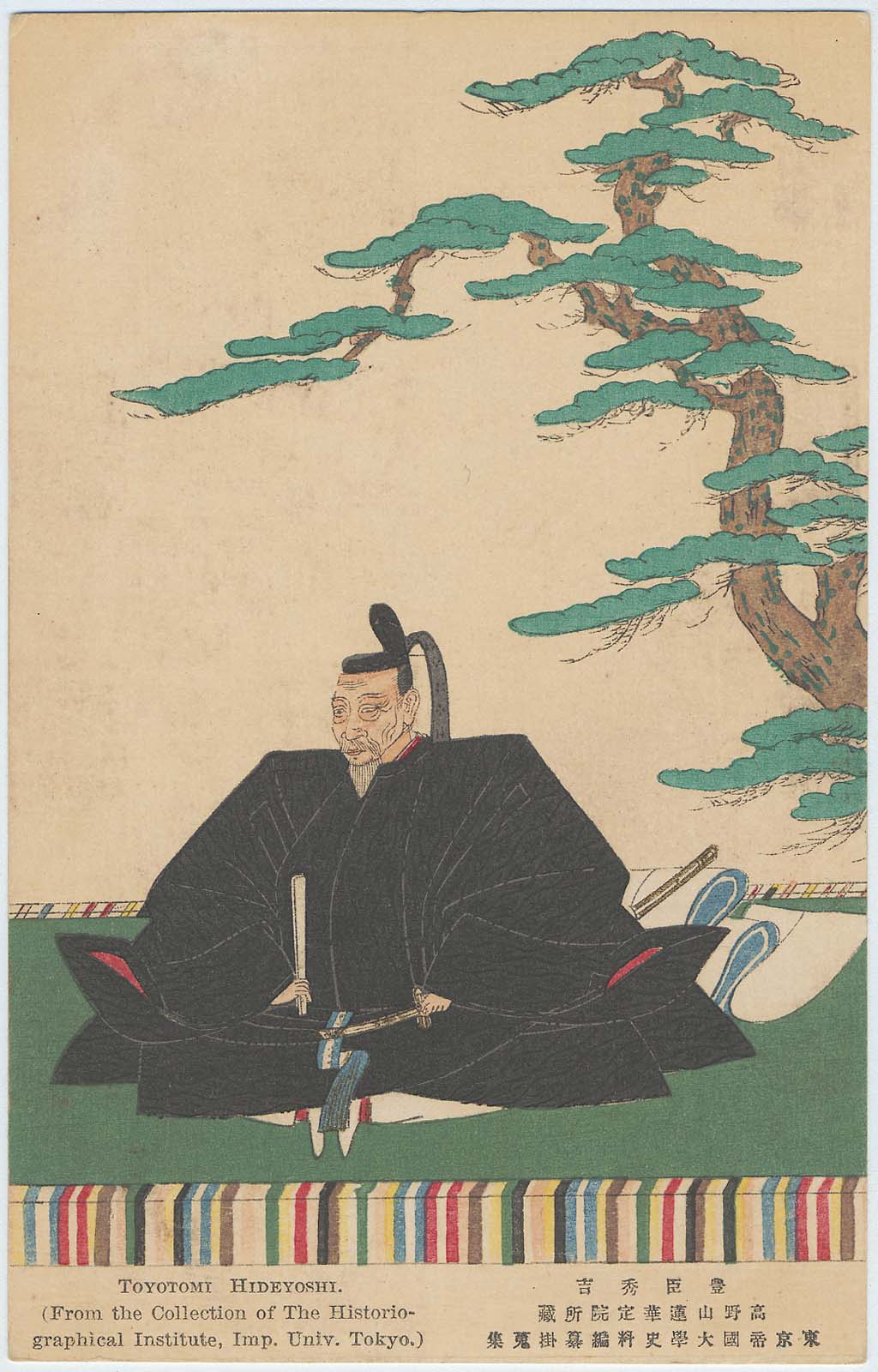
Toyotomi Hideyoshi
(1536 – 1598)
Toyotomi Hideyoshi (豊臣 秀吉, March 17, 1537 – September 18, 1598) was a preeminent daimyō, warrior, general, samurai, and politician of the Sengoku period who is regarded as Japan’s second “great unifier”. He succeeded his former liege lord, Oda Nobunaga, and brought an end to the Sengoku period. The period of his rule is often called the Momoyama period, named after Hideyoshi’s castle. After his death, his young son Hideyori was displaced by Tokugawa Ieyasu.
Hideyoshi is noted for a number of cultural legacies, including the restriction that only members of the samurai class could bear arms. He financed the construction, restoration and rebuilding of many temples standing today in Kyoto.
In February 1591, Hideyoshi ordered Sen no Rikyū to commit suicide. Rikyū had been a trusted retainer and master of the tea ceremony under both Hideyoshi and Nobunaga. Under Hideyoshi’s patronage, Rikyū made significant changes to the aesthetics of the tea ceremony that had a lasting influence over many aspects of Japanese culture. Even after Rikyū’s death, Hideyoshi is said to have built his many construction projects based upon aesthetics promoted by Rikyū.
Following Rikyū’s death, Hideyoshi turned his attention from tea ceremony to Noh, which he had been studying since becoming Imperial Regent. During his brief stay in Nagoya Castle in what is today Saga Prefecture, on Kyūshū, Hideyoshi memorized the shite (lead roles) parts of ten Noh plays, which he then performed, forcing various daimyōs to accompany him onstage as the waki (secondary, accompanying role). He even performed before the emperor.
Visiting Tenshin Okakura
Shortly after the establishment of Okada Enterprises, as Master Jinsai began to study personal ornaments and put his energy into their manufacture, he availed himself of every possible opportunity to deepen both his knowledge and his understanding. Around this time, Master Jinsai made a call that deserves special attention. He went to see Kakuzo Okakura (1862-1913), one of the founders of the Tokyo School of Fine Arts. Not only was Okakura a well-known authority in Japanese art circles, but he was also the author of three English-language books, “The Ideals of the East”, “The Book of Tea”, and “The Awakening of Japan”. Moreover, he served for a time as curator of Chinese and Japanese art at Boston ‘s Museum of Fine Arts and was widely known as a pioneer in introducing Japanese civilization abroad.
Okakura entered the Faculty of Letters of the Imperial University in Tokyo in 1877. While he was a student there, the American Orientalist Ernest Fenollosa (1853- 1908), who was teaching philosophy and economics at the time, befriended him. Fenollosa also had a deep love for the fine arts and was making a serious study of Japanese art. Okakura had the opportunity to act as Fenollosa’s interpreter, and his talent and skill in English led Fenollosa to use him as an assistant. This experience awakened him to the traditional arts of Japan. Meeting Fenollosa changed his course in life, which also suggests how hard it is to predict where a person’s path may lead.
Later, in resistance to the drift toward the complete Westernization of Japan and in order to revive Japanese art, Okakura devoted himself to establishing the Tokyo School of Fine Arts. After his appointment as acting president, in 1890, he eventually became president, while also continuing as professor. Several years later, in 1897, when Master Jinsai enrolled in the school, Okakura was still president, and he also lectured on history.
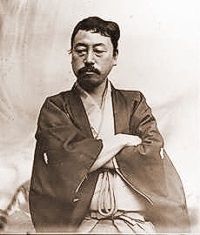
However, in 1898 a controversy arose over the graduation painting Widow and Orphan by Shunso Hishida (1874-1911). A riot took place and in March of the next year, accepting responsibility for the disturbance, Okakura resigned his post after eight years as president.
Determined to begin again, however, Okakura and a number of supporters then established a private school for the study of the fine arts, the Japan Art Institute, in rivalry with the state-run Tokyo School of Fine Arts. The Japan Art Institute became the base for a movement to encourage traditional Japanese arts. Further controversy ensued when some of Okakura’s folIowers, including Shunso Hishida, Kogetsu Saigo (1873-1912), Kanzan Shimomura (1873- 1930), and Taikan Yokoyama (1868-1958), developed a suppressed line technique that they used in their painting. Probably nothing was more basic to the traditional concept of painting in China and Japan than the calligraphic line. The suppressed-line technique, which depended mostly on color, light, and shadow to create shapes and images, represented an attempt to adapt the laws of perspective and the Western manner of sketching to the brushwork and coloration used in Japanese painting. Proponents of the new technique abandoned traditional brushwork, with its exclusive dependence on the calligraphic line.
The new works by Taikan and his colleagues were ridiculed as “hazy paintings,” because of their impressionistic vagueness of outline, and the entire group eventually found themselves hard put to take a living. Toward the end of 1906 Okakura – along with Taikan, Shunso, Kanzan, and Buzan Kimura (1876-1942) – was forced to move the Japan Art Institute from Tokyo to Izura, a remote seaside village in the northern part of Ibaraki Prefecture facing the Pacific Ocean. In spite of their high ideals and aspirations, they lived in what amounted to self-imposed exile.
Most likely, Master Jinsai visited Okakura at Izura soon after he settled there. In 1949, Master Jinsai wrote about the occasion: “More than thirty years ago, Kakuzo Okakura had taken four great painters- Taikan, Shunso, Kanzan, and Buzan – with him to Izura, in the old province of Hitachi, where they lived in seclusion. At that time I had a certain reason to go and see Professor Okakura. There he told me of his hopes for the future of Japanese painting. I learned a lot from his talk and was reminded yet again of what a remarkable person he was. I stayed up all night talking with Kanzan Shimomura and Buzan Kimura.
“‘Professor Okakura’s idea in founding the art institute was to revitalize the style of Korin in modern times”, Mr. Shimomura told me at the time. “That is why we don’t use lines. Today people scorn us and speak of our paintings as belonging to the “hazy school,” but eventually our work will surely be recognized.” Just as he predicted, the institute’s style soon afterward became dominant in Japanese painting circles and, as is well known, revolutionized Japanese painting.”
Exactly when this visit to Izura took place is not known, but records suggest that it was in 1907, sometime between March and October. At that time the trip from Tokyo to Izura took more than six hours by rail. This was not long after Master Jinsai had opened his wholesale house, so each day must have seemed busier than the last. Yet, despite the pressure of work, he took two full days for the visit. Concerning his motive for the trip, he spoke merely of a “certain reason,” and the details are not clear.
Since Okakura had been the president of the Tokyo School of Fine Arts and more recently had led a new art movement, Master Jinsai presumably went to seek some sort of instruction. We may imagine that Okakura tapped the inexhaustible resources of his mind and offered Master Jinsai a number of valuable suggestions, which may have been related to the design of personal ornaments that Master Jinsai had been brooding over. In any case, their conversation must have ranged from one topic to another, touching on art all over the world, and Okakura, with his characteristic forthrightness and his usual passion, surely shared his own ideals regarding the creation of a new art.
The acquaintance between the painters and Master Jinsai continued over the years. Postcards that Buzan Kimura sent to him in 1936 and 1937 still survive. And sometime between 1941 and 1943 the Japanese-style painter Nampu Katayama (1887-1980), recipient of the Order of Cultural Merit and also a member of the Japanese Academy of Art, and who later became a member of Sekai Kyusei Kyo, was taken by his teacher Taikan Yokoyama to visit Master Jinsai at Master Jinsai’s suburban Tokyo home.
As mentioned earlier, Master Jinsai called his first shop Korin-do. Already at that time he revered Ogata Korin, took him as an artistic model, and hoped to follow in his footsteps. No doubt, he expressed his love of Korin’s art to Okakura and his followers. Among them, Kanzan in particular shared Okakura’s belief that real art was that which reflected the spirit of Korin’s style, since Korin’s works were thought to represent the highest achievement of native Japanese art in the Edo period. One may be sure that while Master Jinsai told Okakura of his love of Korin’s work he also listened attentively to Okakura’s opinions. The night of his visit he discussed Korin with Kanzan and Buzan. Kanzan, especially, understood what Master Jinsai was driving at and encouraged him.
The meeting with Okakura at lzura and the intimate talks with Kanzan and Buzan must have given Master Jinsai greater confidence in his own ideas and objectives. Soon afterward, buoyed up by this confidence, he began manufacturing personal accessories and successfully expressed the grace and beauty of the Rimpa school in his lacquer ware combs and his hairpins. Then two years later he won the first of his bronze medals.
Long afterward, as he devoted himself to collecting Rimpa-style art and gave instructions for building the Sacred Grounds of Sekai Kyusei Kyo in Hakone and Atami, he completed landscape gardens that embraced a full measure of creative elements derived from the Rimpa sensibility. All these activities suggest the varied ways the idea of reviving Korin’s style was given concrete expression.
Korin displayed his talent not only in painting but in handicraft products as well and left outstanding examples of lacquerware. Among them are also some combs. At a time when Master Jinsai was immersed in the study of designs for personal adornments, Korin’s style deeply fascinated him, and he did everything possible to grasp its essence. Assuredly, the night in Izura had a decisive impact on the path that he was to follow later.